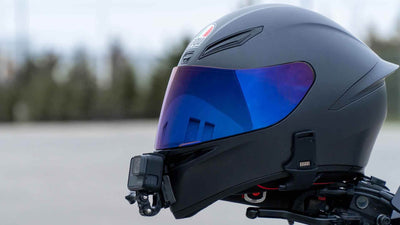
Understanding How Helmet Camera Mounts Are Made
Almost all helmet-specific camera mounts on the market today are 3D printed. In a previous article linked below, we covered the technical disadvantages of 3D-printed mounts compared to injection-molded mounts in detail. In short, the key differences come down to adhesion reliability, structural integrity, surface conformity, and long-term durability.
3D Printed vs Injection Molded Camera Mounts >>
With more chin mount brands entering the market every year, it has become increasingly difficult for riders to determine how a mount is actually manufactured. Below are practical tips to help you identify whether the mount you are considering is 3D printed or injection molded.
Key Differences at a Glance
3D printed mounts typically involve:
-
Layered construction with visible layer lines
-
Non-uniform surfaces that reduce adhesive performance
-
Structural weak points between layers
-
Limited material selection using off-the-shelf filament
Injection molded mounts typically offer:
-
A single solid structure with no layers
-
Uniform, non-porous surfaces optimized for adhesive bonding
-
Higher conformity to helmet curvature
-
Custom-formulated materials engineered for strength, UV resistance, and adhesion
Marketing Language That Avoids Saying “3D Printed”
Many sellers do not clearly state that their mounts are 3D printed. This is often done to protect brand reputation and maintain sales.
Instead, product descriptions frequently rely on vague terms such as lightweight, strong, durable, or custom made without ever disclosing the manufacturing method. Some brands list filament material names like ABS (Acrylonitrile Butadiene Styrene) or ASA (Acrylonitrile Styrene Acrylate) to sound more technical or premium. In reality, these are common off-the-shelf filaments that can be purchased from Amazon or standard suppliers.
This practice is common across standalone brand websites, marketplace listings, and offshore storefronts.
A clear lack of transparency around the manufacturing process is often the first indicator that a mount is 3D printed.
Product Images That Hide Layer Lines
Another major warning sign is the absence of zoomable images or close-up photos.
Many 3D-printed chin mount sellers intentionally display the mount at a small scale in images to make layer lines difficult to see. By avoiding detailed close-ups, they prevent customers from noticing the stepped surface texture inherent to planar 3D printing.
Instead, these listings rely heavily on descriptive language to build trust, assuming buyers will not question the manufacturing method as long as the product appears clean at a distance.
If a listing avoids detailed surface shots, it is often because the surface would reveal that the mount is 3D printed.
Thickness and Geometry as a Clue
A more advanced way to identify a 3D-printed mount is by examining its thickness and overall geometry.
If a mount appears bulky, has unusually thick walls, or uses exaggerated shapes, it is likely 3D printed. Layer-based manufacturing often relies on increased wall thickness to compensate for weaker inter-layer strength and inconsistent surface quality.
Injection molding does not require excessive thickness to achieve strength. In fact, thick walls in injection molding can cause surface defects, sink marks, and internal stress. As a result, injection-molded mounts are typically thinner, more refined, and more consistent in shape.
How Injection Molded Mounts Are Presented
In nearly all cases, if a mount is injection molded, it will be clearly labeled as such in both the product description and images.
Injection molding requires significant upfront investment in tooling and engineering. Brands that commit to this manufacturing method have no reason to hide it. Clear disclosure is common because injection molding is the proper way to manufacture helmet camera mounts intended to keep an action camera secure under vibration, wind load, and long-term use.
Injection-molded mounts also tend to highlight:
-
Precision fit
-
Uniform surface finish
-
Custom material formulation
-
Long-term reliability
Why Manufacturing Method Matters
The way a mount is made directly affects how well it bonds to adhesive, how it conforms to a helmet, and how long it remains secure. Manufacturing method is not a cosmetic detail. It is a performance-critical decision.
Choosing an injection-molded mount means choosing a product designed for structural integrity, consistent adhesion, and real-world riding conditions. For riders who rely on their action camera for daily commuting, documentation, or content creation, this distinction matters.
Understanding how to identify the manufacturing method helps you make an informed decision and avoid preventable failures caused by material and process limitations.